
What Are Neuromodulators? A Complete Patient Guide
Neuromodulators are injectable medications that temporarily relax specific facial muscles. You likely know them by their brand names — Botox, Dysport, Xeomin, Jeuveau — but they all share the same active ingredient: botulinum toxin type A.

Despite their popularity, many patients don't fully understand what these treatments do, how they work, or why the person injecting them matters more than the product itself. This guide covers everything you need to know.

How Neuromodulators Work
Every time you smile, frown, or raise your eyebrows, tiny muscles beneath your skin contract. Over years of repetitive movement, these contractions create creases in the overlying skin. Eventually, those creases become visible even when your face is at rest — these are the lines we call "dynamic wrinkles."
Neuromodulators work by temporarily blocking the nerve signals that tell those muscles to contract. When the muscle can't contract as strongly, the overlying skin has a chance to smooth out.
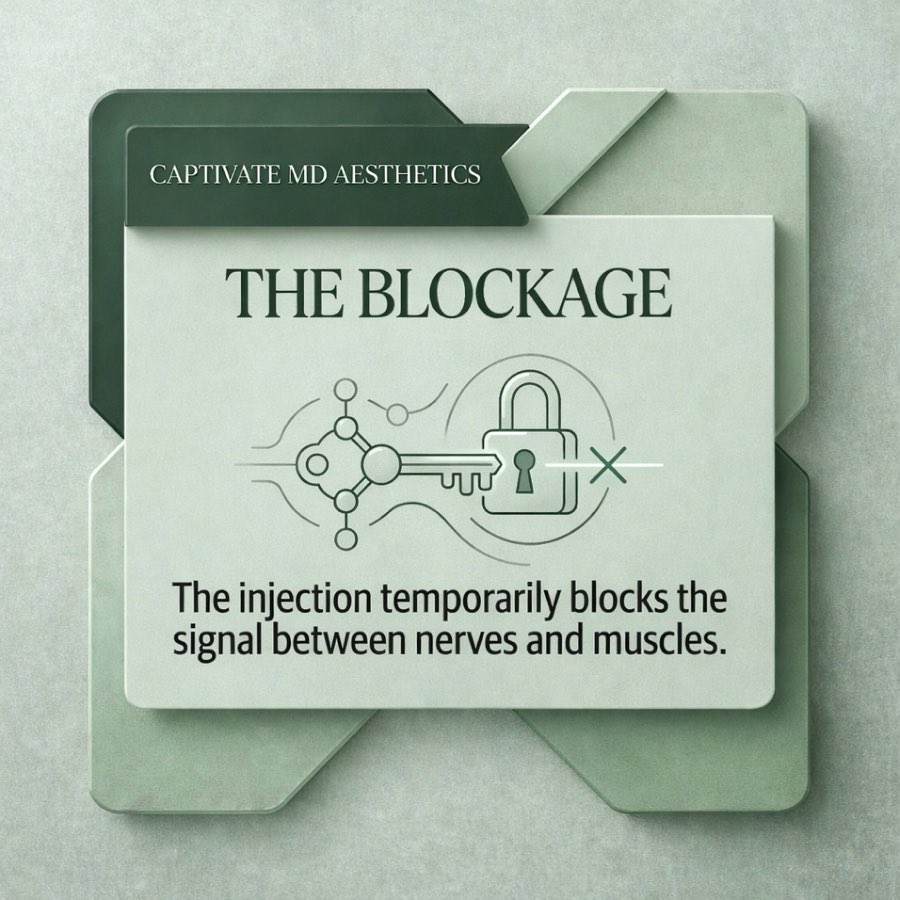
The key word is "temporarily." Neuromodulators do not paralyze your face. A skilled injector uses precise, conservative amounts to soften movement — not eliminate it. The goal is a natural, refreshed look where you can still express yourself fully.
What Neuromodulators Treat
Neuromodulators are most effective for dynamic wrinkles — the lines that appear with facial expression:
- •Forehead lines — horizontal creases that appear when you raise your eyebrows
- •Glabellar lines (the "11s") — vertical lines between the eyebrows that form when you frown
- •Crow's feet — lines at the outer corners of the eyes that appear when you smile or squint
- •Bunny lines — wrinkles on the bridge of the nose
- •Lip lines (smoker's lines) — vertical lines around the mouth
- •Chin dimpling — the "orange peel" texture that appears on some chins
- •Masseter reduction — slimming the lower face by relaxing the jaw muscle
- •Gummy smile — reducing excessive gum display by relaxing the upper lip elevator
- •Neck bands — softening visible platysmal bands for a smoother neck contour
The Different Products
All FDA-approved neuromodulators use the same core ingredient, but there are meaningful differences:
Botox (onabotulinumtoxinA) The original and most well-known. FDA-approved since 2002 for cosmetic use. Tends to have a slightly more localized effect, making it precise for targeted areas. Results appear in 5–7 days.
Dysport (abobotulinumtoxinA) Diffuses more broadly from the injection site, which can be advantageous for larger treatment areas like the forehead. Many patients notice results faster — within 2–3 days. Uses different dosing units (roughly 2.5–3 Dysport units equal 1 Botox unit).
Xeomin (incobotulinumtoxinA) Known as the "naked" neuromodulator because it contains no accessory proteins — only the purified active ingredient. This may reduce the risk of developing antibodies over time. Results comparable to Botox.
Jeuveau (prabotulinumtoxinA) A newer option sometimes marketed as "Newtox." Similar profile to Botox. Some patients report slightly faster onset.
Which is best? There is no universally superior product. The right choice depends on your individual anatomy, the treatment area, and your injector's experience. Dr. Taborga evaluates each patient and recommends the product most likely to deliver the best result for their specific needs.
The Treatment Experience
- Consultation: Dr. Taborga evaluates your facial anatomy, discusses your goals, and maps out injection points
- Preparation: The treatment area is cleansed; ice or numbing cream may be applied
- Injection: Using a very fine needle, small amounts are placed into specific muscles — typically 5–10 minutes for a standard treatment
- Aftercare: You may notice tiny bumps at injection sites that resolve within minutes. Avoid rubbing the area for 24 hours
Discomfort is minimal — most patients describe it as a brief pinch. No anesthesia is typically needed.
What to Expect
- •Onset: 2–7 days depending on the product and treatment area
- •Peak effect: 10–14 days after treatment
- •Duration: 3–4 months on average (some patients get 4–6 months with consistent treatment)
- •Downtime: None — return to normal activities immediately
Why Your Injector Matters
This is perhaps the most important point in this entire guide. Neuromodulators are prescription medications that should only be administered by or under the direct supervision of a licensed physician.
A skilled injector understands: - The complex anatomy of facial muscles — which to target and which to leave alone - How treating one area affects adjacent areas (relaxing the forehead too aggressively can drop the brows) - The precise dosage for your anatomy — every face is different - How to manage rare but serious complications like vascular occlusion
Dr. Taborga performs every injection himself. As a board-certified Internal Medicine physician with advanced training in facial harmonization, he brings the deep anatomical knowledge that safe, beautiful results require.
Common Questions
"Will I look frozen?" Not when treated correctly. Dr. Taborga uses conservative doses that soften wrinkles while preserving natural expression. The goal: you look refreshed, not "done."
"Is it safe?" Botox has been used medically since 1989 and cosmetically since 2002, with hundreds of millions of treatments performed worldwide. It has an exceptional safety profile when administered by a qualified physician.
"Will I need more over time?" Most patients maintain results with regular treatments every 3–4 months. Some patients find they need less frequent treatments over time as the targeted muscles weaken from repeated relaxation.
"Can I stop anytime?" Yes. When you stop treatment, the effects gradually wear off and your muscles return to normal function. Your wrinkles will return to how they would have been without treatment — not worse.
## Ready to Learn More?
If you're considering neuromodulators, the first step is a consultation where Dr. Taborga can evaluate your anatomy, discuss your goals, and create a personalized treatment plan.
Call (332) 237-3661 to schedule your consultation.
Sources & Further Reading
Ready to Get Started?
Schedule a consultation with Dr. Taborga to discuss your goals.
Or explore our Botox & Dysport treatment in NYC's Flatiron District.